
Summary
On February 20, 2025, the Department of Education launched the Education Center for AI Research (ECAIR) in Pasig City. As the first-ever hub for AI research in education in the Philippines, ECAIR is tasked with driving innovation across the sector through AI-powered solutions aligned with DepEd's 5-Point Reform Agenda. The launch builds directly on the pioneering work that the Center for AI Research (CAIR) began in 2024; under DepEd's leadership, ECAIR will sustain, deepen, and expand that mission.
What ECAIR Is For
ECAIR's mandate is to revitalize basic education by developing AI-driven tools that strengthen three areas at once: teaching, learning, and school administration. This realizes President Ferdinand R. Marcos Jr.'s commitment to modernizing the education sector so that Filipino students gain access to quality, technology-driven learning that meets global standards. The Center is designed to be collaborative and inclusive, working with national and local government agencies alongside industry partners, and it aligns with the administration's broader vision of digital transformation across governance, education, and economic growth.
Work Already Underway
ECAIR did not launch from a standing start. The Center is already driving AI solutions for learners and teachers nationwide, including optimizing education voucher distribution, using computer vision to screen stunted and wasted learners, improving the detection and screening of learners with disabilities, mapping natural hazards across public and private schools, strengthening public-private partnerships through the Adopt-A-School Program, and building up the competencies of school heads.
Several of these lines of work point to near-term expansion. Data-driven mapping under Adopt-A-School will help identify schools with infrastructure needs. ECAIR can also support the agency by generating computer-based examination results and offering insights to enhance the qualification system for the National Qualifying Examination for School Heads (NQESH).
A Regional Ambition
Through its partnership with the Southeast Asian Ministers of Education Organization (SEAMEO), DepEd aims to position the Philippines as the AI education hub in Southeast Asia, pioneering and scaling AI-driven solutions that address education challenges shared across the region.
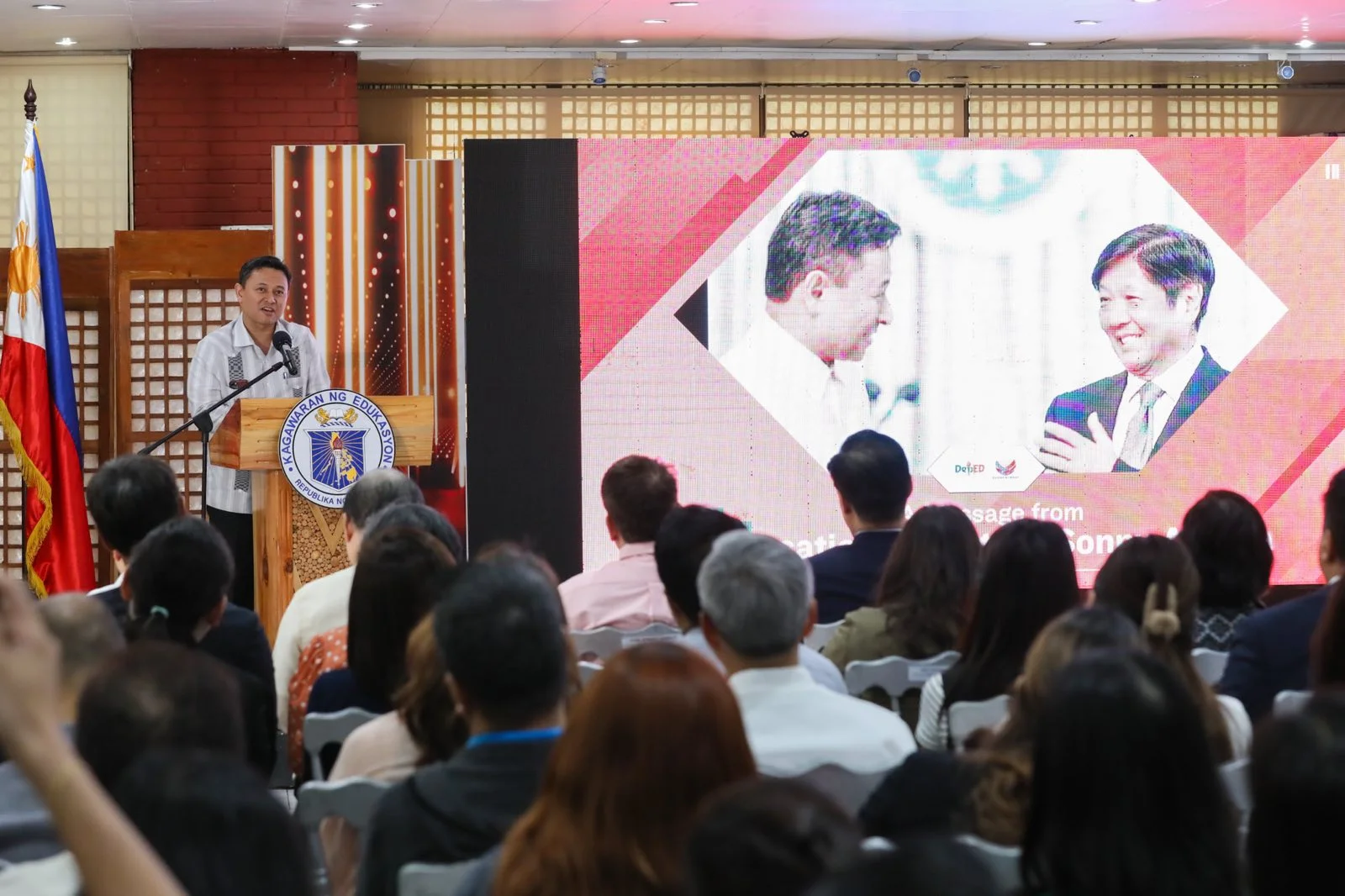
Education Secretary Sonny Angara framed the ambition plainly in his keynote: "Hindi po tayo makikipagsabayan para lang masabi na 'tech-savvy' tayo. We are here to use AI as a tool for genuine, enduring reforms. This is the promise of the President's Bagong Pilipinas."
The launch drew leaders from the public and private sectors, including Senate Committee on Basic Education Chairperson Sen. Win Gatchalian, House Committee on Basic Education and Culture Chairperson Rep. Roman Romulo, TESDA Director-General Jose Francisco Benitez, and DICT Secretary Ivan John Uy.