
Abstract
Cities deliver basic services through mixed public-private facility networks — schools, clinics, transit providers, and subsidized service points. Planners in these systems observe where households go, but not the latent cost function through which households trade off distance, price, and institutional access. This paper studies that problem through school choice in the Philippines, where the country's largest national education subsidy is intended to redirect learners from congested public schools to participating private schools. Treating school-to-school enrollment flows as an entropic optimal transport plan, the work recovers latent choice costs with two complementary inverse optimal transport models: an interpretable distance-banded model with a subsidy term, and a neural cost model trained through a differentiable Sinkhorn forward pass. Applied to 283,016 learner trips across 23,820 observed flows in the most populated region, the framework estimates a subsidy-equivalent distance interpreted as the kilometers of perceived travel cost offset by the subsidy.
Method
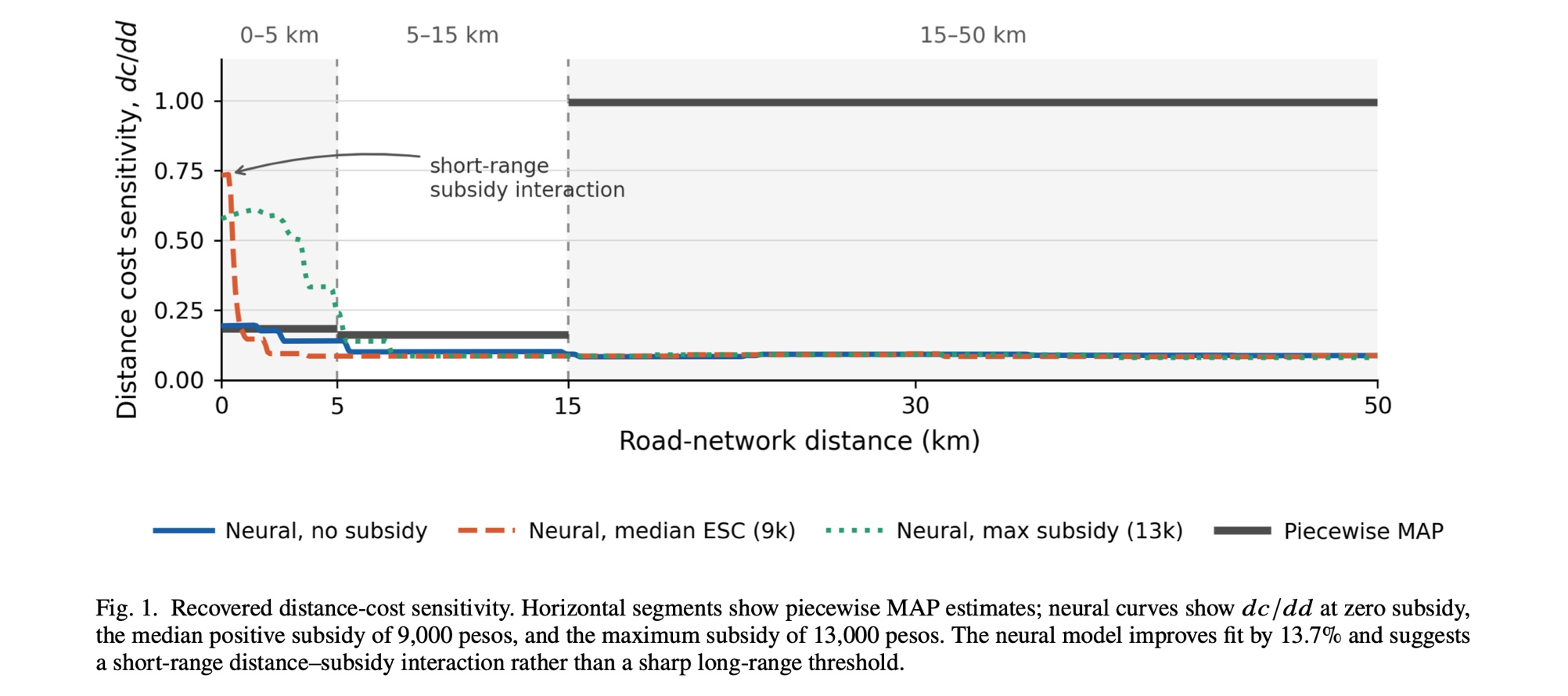
Observed school-to-school enrollment movements are modeled as an entropic optimal transport plan, and the inverse problem asks which cost surface would produce the flows administrative data actually records. Two models are fit against the same flows. The distance-banded model, with an explicit subsidy term, stays legible to planners: its coefficients can be read directly as the weight households place on distance and on subsidy eligibility. The neural cost model, trained by backpropagating through a differentiable Sinkhorn forward pass, relaxes the functional form and captures cost structure the banded model cannot express. Together they trade interpretability against flexibility while producing a common planning quantity — the subsidy-equivalent distance.
Relevance to ECAIR
The paper extends the same evidence base as ECAIR's decongestion and resource-optimization work, where Student Flow Modeling for School Decongestion estimates how learners move between residential areas and schools. Where that work projects and reallocates demand, this one asks what the observed movement reveals about the cost households are willing to bear. Expressing a subsidy in kilometers of offset travel gives subsidy design, facility siting, and service allocation a unit that budget and planning discussions can use, and it does so from administrative origin-destination data the system already collects.
Citation
Martinez, P. J. (2026). Learning Urban Access Costs from Origin-Destination Flows via Inverse Optimal Transport. 2026 International Conference on Urban AI. arXiv: https://arxiv.org/abs/2606.14157