
Abstract
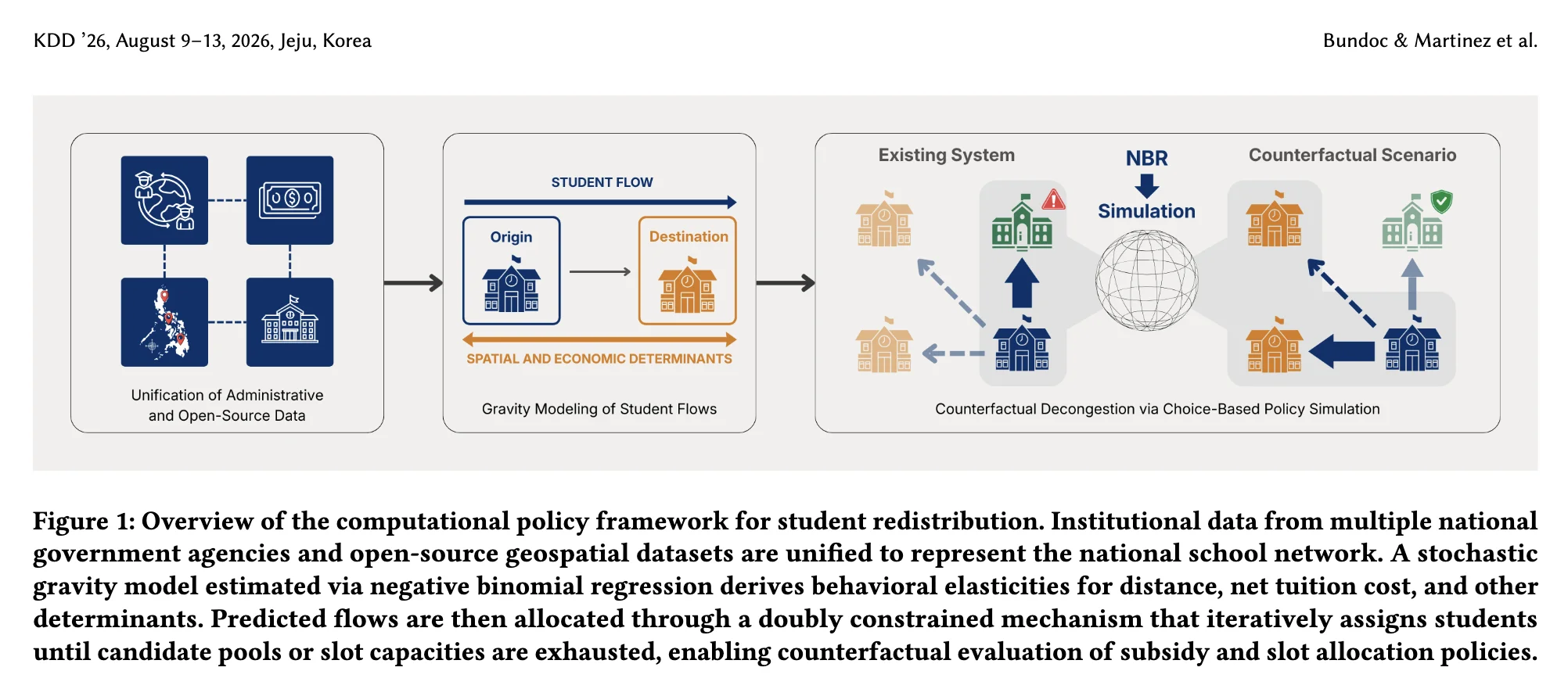
This paper presents a framework for modeling student flows to support school decongestion, combining stochastic gravity estimation with constrained spatial allocation. The approach estimates how learners move between residential areas and schools and reallocates projected demand under capacity and geographic constraints, providing evidence for enrollment and infrastructure planning in congested public school systems.
Method
The method pairs a stochastic gravity model, which estimates origin–destination student flows from population, distance, and capacity signals, with a constrained spatial allocation step that redistributes demand subject to school capacity limits and spatial feasibility.
Relevance to ECAIR
The work supports ECAIR's decongestion and resource-optimization agenda, offering a data-driven basis for deciding where added capacity and reallocation can most reduce overcrowding across the national school network.
Citation
Student Flow Modeling for School Decongestion via Stochastic Gravity Estimation and Constrained Spatial Allocation. Presented at KDD 2026, AI4Sciences Track. arXiv: https://arxiv.org/abs/2602.17972