
Summary
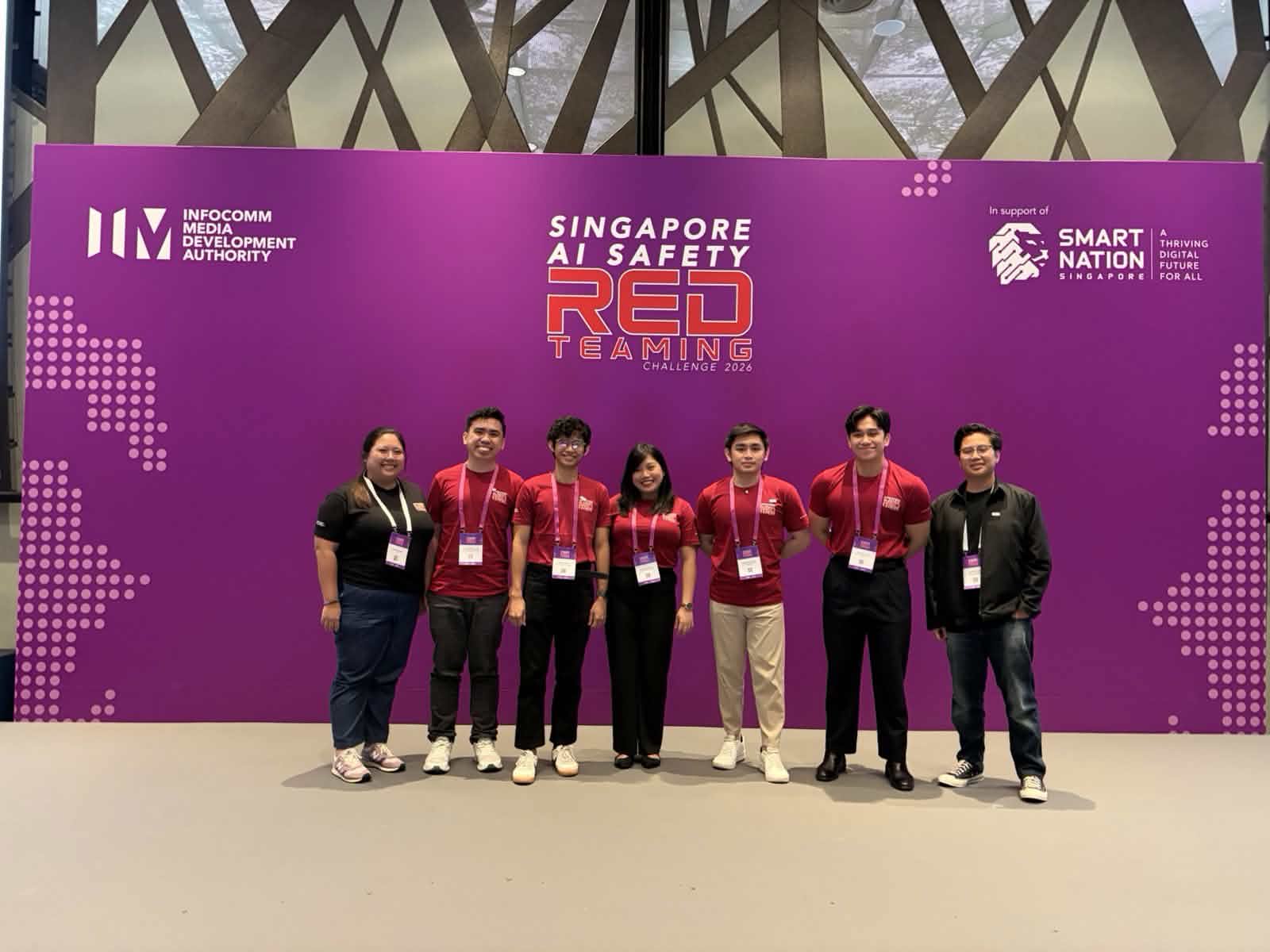
From January 19 to 21, 2026, the Education Center for AI Research (ECAIR) took part in the Singapore AI Safety Red Teaming Challenge 2026, a regional exercise hosted by the Infocomm Media Development Authority (IMDA) that brought together AI developers, policymakers, linguists, researchers, and safety practitioners from across Southeast and East Asia. ECAIR was represented by Derrick Tan, Elmo Jose, Christian Villarin, Christopher Nash Jasmin, and Danielle Carreon, who joined the challenge to stress-test large language models and identify risks, failures, and unintended behaviors before such systems are deployed in real-world settings.
The exercise is directly relevant to ECAIR's work in education and public service, where AI systems can shape decisions, information, and services that affect large numbers of learners, teachers, and communities.
Testing AI Before Real-World Deployment
AI red teaming means deliberately testing an AI system for weaknesses and unsafe behavior. Participants probe models with difficult, adversarial, or unexpected prompts to find where safeguards fail, where outputs become unreliable, and how systems behave in situations their developers did not anticipate. The practice turns AI safety from a set of broad principles into a working process for identifying risks before they cause harm.
Through the challenge, the ECAIR delegation gained hands-on exposure to methods for evaluating harmful or misleading outputs, bias, inappropriate responses, circumvention of safeguards, and the risks that emerge from differences in language and cultural context.
Why This Matters for Philippine Education
As AI becomes more embedded in education, it is not enough for a system to be useful. It also has to be tested for how it behaves when faced with difficult, ambiguous, or potentially harmful situations. The lessons from the challenge inform ECAIR's approach to AI governance, particularly the practical safeguards, risk assessments, testing protocols, and monitoring mechanisms that AI systems used in education require.
ECAIR's participation also brings Philippine perspectives into regional conversations on AI safety. As models are deployed more widely across Southeast Asia, safety evaluations need to account for local languages, cultural contexts, public-sector environments, and the realities of users in the region.