
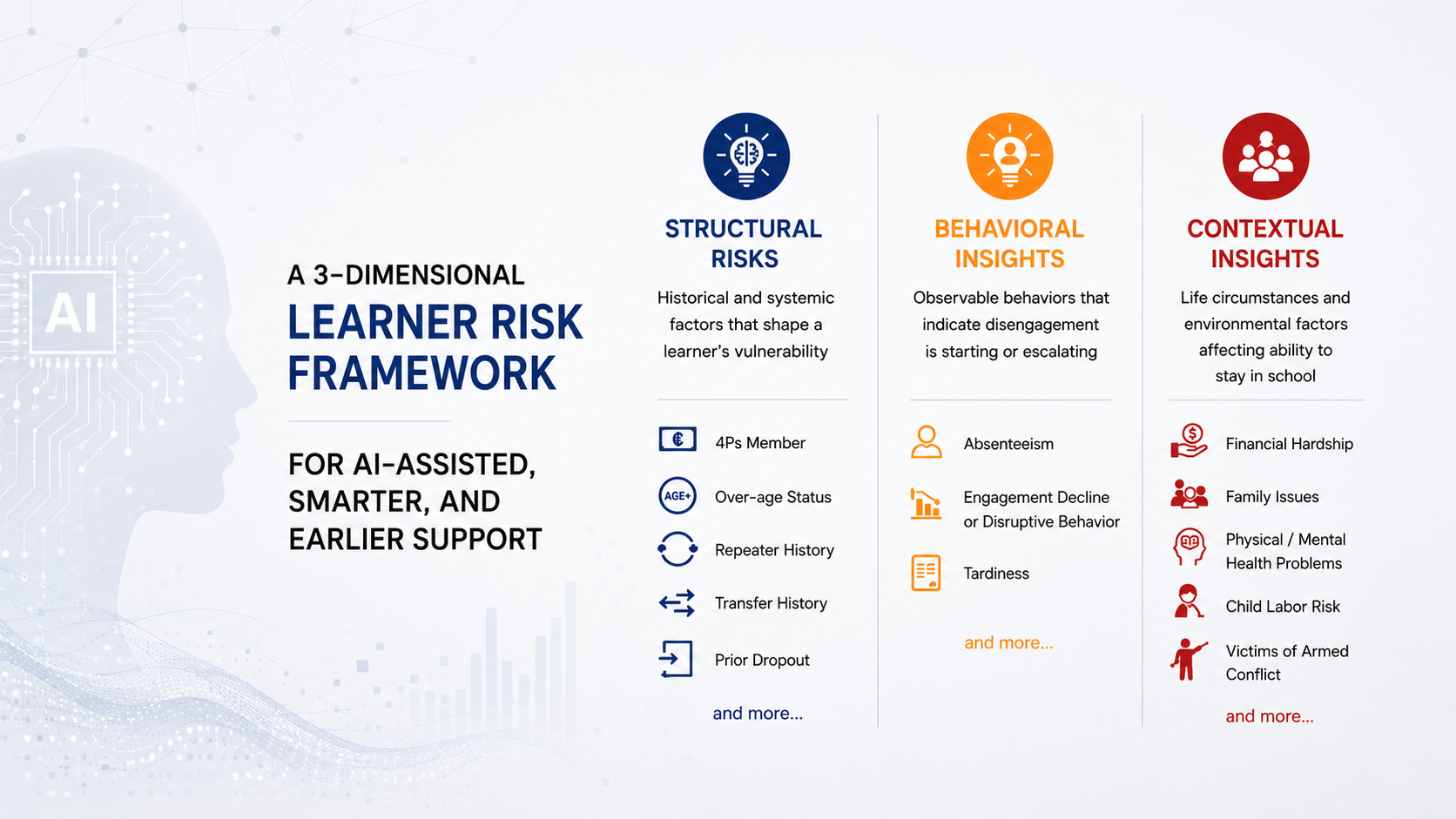
TAWID, Tracking and Analyzing the Warning Indicators of Dropout Risk, uses machine-learning experimentation to model learner dropout-risk indicators using LIS-linked data structures. It is developed alongside TALAAN so dropout-risk analysis can connect to governed learner analytics and school-level intervention thinking. Its public value is helping DepEd move toward earlier, better-targeted support for learners at risk of disengaging.
TAWID supports EDCOM II reform themes on learner retention, targeted intervention, and evidence-informed school support. It aligns with Q-BEDP priorities on early warning and learner-centered support, PREXC needs for intervention planning, and Philippine Development Plan goals on human capital development through reduced dropout risk.
OUPPE leadership is the process owner, with related TALAAN stakeholders involved because the projects share data-governance and deployment logic. ECAIR's role is to conduct machine-learning experimentation, prepare the policy brief, and align handover logic with the broader learner analytics pathway.
The project is in its machine-learning experimentation phase, with a policy brief planned as the next output and its approach aligned with the TALAAN learner-analytics pathway.